Dive into a forensic career with the Underwater Crime Scene Investigation (UCSI) certificate. This program offers a rigorous, applied study of underwater forensic research and investigation, blending theoretical methodology with high-stakes practical experience. Available to both FSU Tallahassee and FSU Panama City students, the certificate can be earned as part of a bachelor’s or master’s degree, or as a standalone credential for non-degree-seeking students.
Our mission is to challenge students through five sequenced courses and laboratories. By mastering critical thinking and mission-driven objectives, graduates emerge as highly qualified underwater forensic scientists ready to lead in global law enforcement and public safety.
-
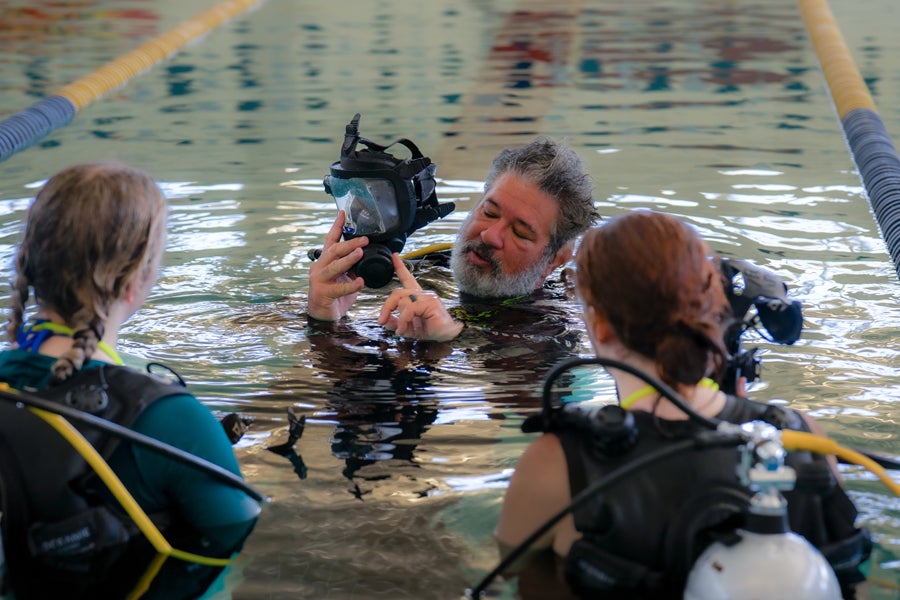
Excellence in underwater research
Graduates are educated to be both scientists and investigators, which benefits science-based disciplines such as engineering, medicine, criminology and archaeology.
-
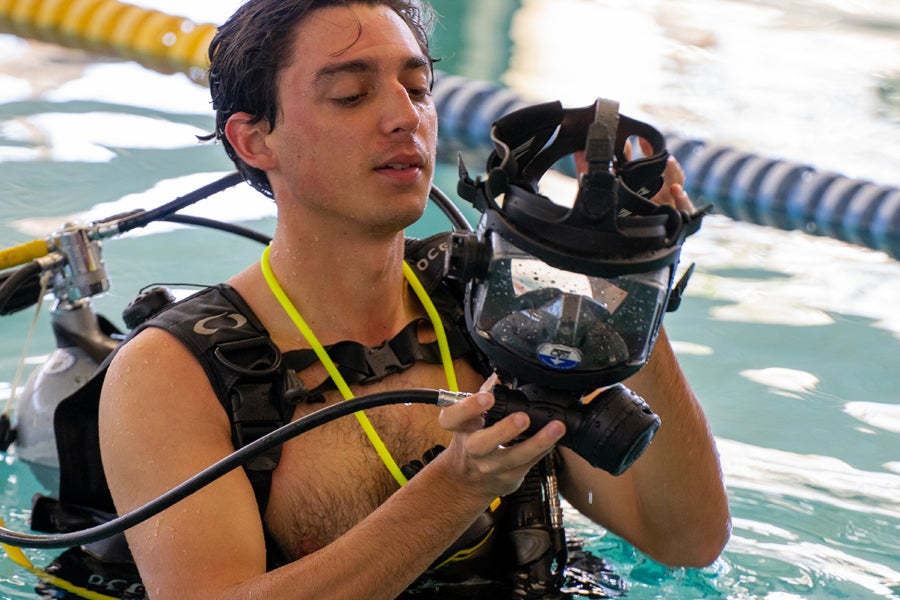
One certificate, unlimited possibilities
The UCSI certificate opens doors for careers in investigations and maritime security.
-
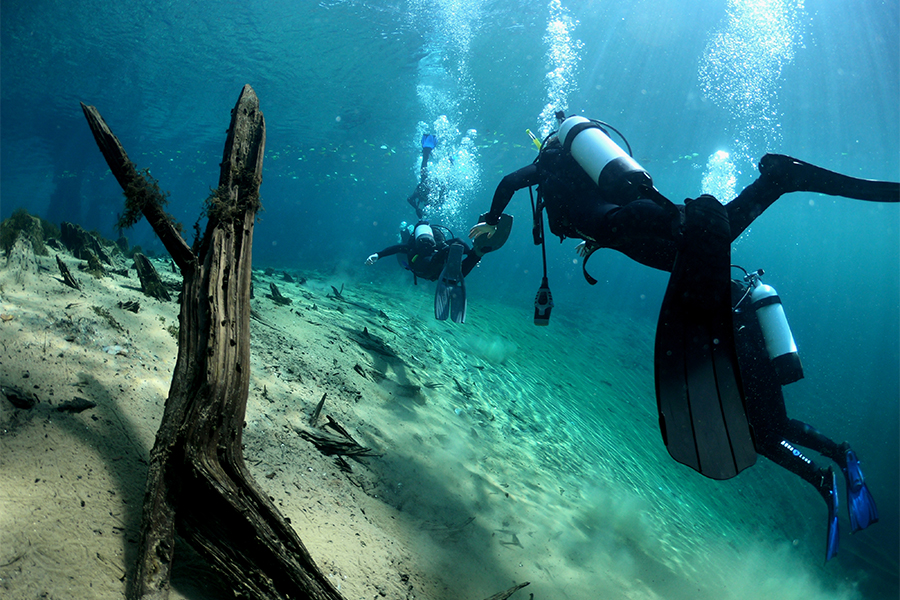
Open doors to scholarship opportunities
Students enrolled in at least 3 hours of a diving class are eligible for the Bob Barth Underwater Research Scholarship.
-
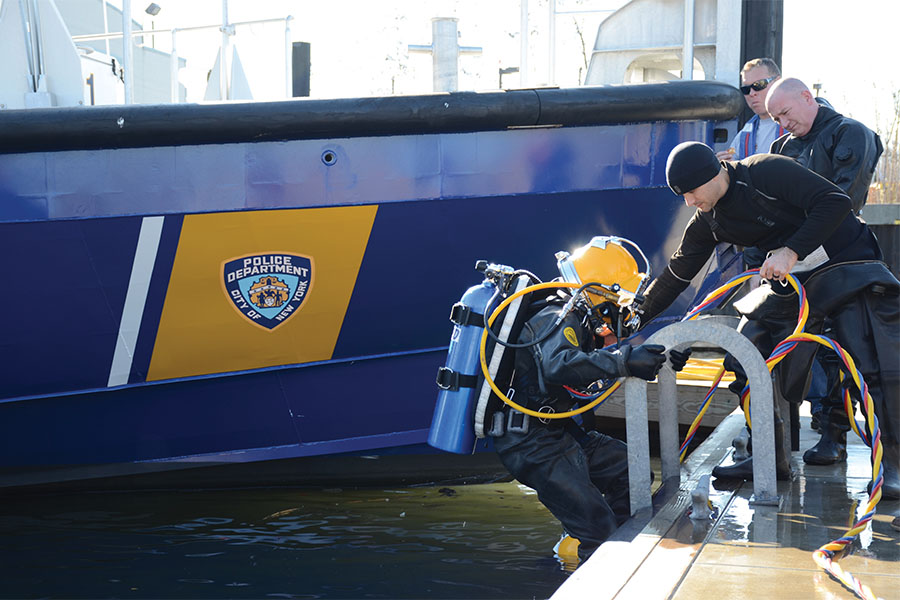
We train the pros
Faculty and students have trained national law enforcement divers and assisted with rescue and recovery missions.
Students Eye View

"I had an interest in crime scene plus I love the water ... and I found out that FSU Panama City has those 2 programs."
- Amber Bosley
crime scene investigation, '17
“Most of the time when I am in the water I have one of the best educations out of all the divers there.”
- Will McEwan
international affairs, '22

“Scuba changed my life, and the program helped guide me to achieve goals I didn’t even know were possible.”
- Sally Pendoley
crime scene investigation, '19
Requirements for Certification
Graduate Certificate in Underwater Crime Investigation - 16 graduate credit hours
To earn a graduate certificate, students must:
- Submit the Graduate UCSI Certificate Program Application (see Quick Links menu for application) and be approved to pursue the UCSI certificate program prior to completion of the second course and lab.
- Complete the required number of graduate credit hours (16) from the approved list of courses.
- Earn a grade of “B” or higher in each of the graduate level courses and labs. Non-degree seeking students pursuing the UCSI graduate certificate must earn a grade of “B” or higher in each of the graduate level courses and labs.
- Complete and submit the UCSI Graduate Certificate Completion Request (see Quick Links menu for request) at the beginning of the term in which the requirements for the certificate will be completed.
- Students cannot mix undergraduate and graduate classes in completing their certificate.
ISC 5060 - Introduction to Underwater Investigation (3) presents the history, principles of basic hyperbaric science diving, physics and physiology as they relate to diving. This course provides the theoretical foundation for individuals preparing to be divers.
ISC 5060L - Introduction to Underwater Investigation Lab (1) presents the principles and practice of compressed-gas as a life-support system for underwater hyperbaric exposure. This course is designed to develop proficiency in the basic skills required to perform safe underwater operations. Certifications earned: Open Water and Advanced Open Water Diver.
Students' transcripts will reflect academic course work only. Professional Scuba certifications, earned through course work, are issued through the International Association of Nitrox and Technical Diver (IANTD) and the American Academy of Underwater Scientists (AAUS). These diving certifications are not credentials issued by FSU and as such will not be documented on the transcript. Additionally, the separate tests or requirements for diving or scientific diver certification, as articulated by IANTD and AAUS, will also not appear on a student's transcripts.
ISC 5061 - Scientific Underwater Investigation (3) builds upon the Introduction to Underwater Investigation course by providing the technology to collect data in an underwater environment according to the scientific method. The course the techniques used in science disciplines that function underwater.
ISC 5061L - Scientific Underwater Investigation Lab (1) builds upon the Introduction to Underwater Investigation Laboratory course by providing the tools and techniques to collect data in an underwater environment for prolonged periods of time. The underwater data collection techniques use traditional underwater technology and techniques for data gathering related to scientific disciplines. Certifications earned: Enriched Air (EANx) Diver and American Academy of Underwater Sciences (AAUS).
Students' transcripts will reflect academic course work only. Professional Scuba certifications, earned through course work, are issued through the International Association of Nitrox and Technical Diver (IANTD) and the American Academy of Underwater Scientists (AAUS). These diving certifications are not credentials issued by FSU and as such will not be documented on the transcript. Additionally, the separate tests or requirements for diving or scientific diver certification, as articulated by IANTD and AAUS, will also not appear on a student's transcripts.
CJE 5768 - Underwater Crime Scene Methodology (3) synthesizes the various theories for the conduct of crime with the knowledge of how physical evidence is produced during the commission of a crime on or under the water in order to produce information that enables the investigation and prosecution of criminal activity.
CJE 5768L - Underwater Crime Scene Methodology Lab (1) applies various techniques for the examination of physical materials generated during the commission of a crime on or under the water in order to produce information that enables the investigation and prosecution of criminal activity. Additional equipment fee required.
CJE 5769 - Underwater Crime Scene Investigation (3) combines the various analytical underwater examinations into a holistic investigation process designed to locate and detect persons and physical evidence involved in, or victims of, crimes in or on the water. Emphasis is placed on the theory of the technology and the scientific decision-making required for its optimum application.
CJE 5769L - USCI Capstone (1) empirically applies methodology based on advanced technology to enhance the location and detection of physical evidence used, or intended for use, in the commission of underwater crimes. Emphasis is placed on the use of the Incident Command System and the UCSI Process for management of an underwater crime scene investigation and on the verification of investigative protocols. Additional equipment fee required.
Advising
Mark Feulner, Advanced Science Diving Program Director
(850) 770-2205
mfeulner@pc.fsu.edu
For more information please contact the College of Applied Studies at appliedstudies@pc.fsu.edu.
Undergraduate Underwater Crime Scene Investigation - 16 undergraduate credit hours
To earn an undergraduate certificate, students must:
- Submit the Undergraduate UCSI Certificate Program Application (see Quick Links menu for application) and be approved to pursue the UCSI certificate program prior to completion of the second course and lab.
- Complete the required number of undergraduate credit hours (16) from the approved list of courses.
- Earn a grade of “C minus” or higher in each of the undergraduate courses and labs.
- Complete and submit the UCSI Certificate Completion Request (see Quick Links menu for request) at the beginning of the term in which the requirements for the certificate will be complete.
- Students cannot mix undergraduate and graduate classes in completing their certificate.
ISC 3062 - Introduction to Underwater Investigation (3) presents the history, principles of basic hyperbaric science diving, physics and physiology as they relate to diving. This course provides the theoretical foundation for individuals preparing to be divers.
ISC 3062L - Introduction to Underwater Investigation Lab (1) presents the principles and practice of compressed-gas as a life-support system for underwater hyperbaric exposure. This course is designed to develop proficiency in the basic skills required to perform safe underwater operations. Certifications earned: Open Water and Advanced Open Water Diver.
Students' transcripts will reflect academic course work only. Professional Scuba certifications, earned through course work, are issued through the International Association of Nitrox and Technical Diver (IANTD) and the American Academy of Underwater Scientists (AAUS). These diving certifications are not credentials issued by FSU and as such will not be documented on the transcript. Additionally, the separate tests or requirements for diving or scientific diver certification, as articulated by IANTD and AAUS, will also not appear on a student's transcripts.
ISC 3063 - Scientific Underwater Investigation (3) builds upon the Introduction to Underwater Investigation course by providing the technology to collect data in an underwater environment according to the scientific method. The course the techniques used in science disciplines that function underwater.
ISC 3063L - Scientific Underwater Investigation Lab (1) builds upon the Introduction to Underwater Investigation Laboratory course by providing the tools and techniques to collect data in an underwater environment for prolonged periods of time. The underwater data collection techniques use traditional underwater technology and techniques for data gathering related to scientific disciplines. Certifications earned: Enriched Air (EANx) Diver and American Academy of Underwater Sciences (AAUS).
Students' transcripts will reflect academic course work only. Professional Scuba certifications, earned through course work, are issued through the International Association of Nitrox and Technical Diver (IANTD) and the American Academy of Underwater Scientists (AAUS). These diving certifications are not credentials issued by FSU and as such will not be documented on the transcript. Additionally, the separate tests or requirements for diving or scientific diver certification, as articulated by IANTD and AAUS, will also not appear on a student's transcripts.
CJE 4764 - Underwater Crime Scene Methodology (3) synthesizes the various theories for the conduct of crime with the knowledge of how physical evidence is produced during the commission of a crime on or under the water in order to produce information that enables the investigation and prosecution of criminal activity.
CJE 4764L - Underwater Crime Scene Methodology Lab (1) applies various techniques for the examination of physical materials generated during the commission of a crime on or under the water in order to produce information that enables the investigation and prosecution of criminal activity. Additional equipment fee required.
CJE 4765 - Underwater Crime Scene Investigation (3) combines the various analytical underwater examinations into a holistic investigation process designed to locate and detect persons and physical evidence involved in, or victims of, crimes in or on the water. Emphasis is placed on the theory of the technology and the scientific decision-making required for its optimum application.
CJE 4765L -USCI Capstone (1) empirically applies methodology based on advanced technology to enhance the location and detection of physical evidence used, or intended for use, in the commission of underwater crimes. Emphasis is placed on the use of the Incident Command System and the UCSI Process for management of an underwater crime scene investigation and on the verification of investigative protocols. Additional equipment fee required.
Advising
Mark Feulner, Advanced Science Diving Program Director
(850) 770-2205
mfeulner@pc.fsu.edu
Dana Smith, Academic Program Specialist
(850) 770-2266
dsmith@pc.fsu.edu
Elective Course
PEN 1136 Theory and practice of compressed-gas diving. Certification earned: Open Water Diver (Summer only)